Great American Gardeners: What the Founding Fathers Knew
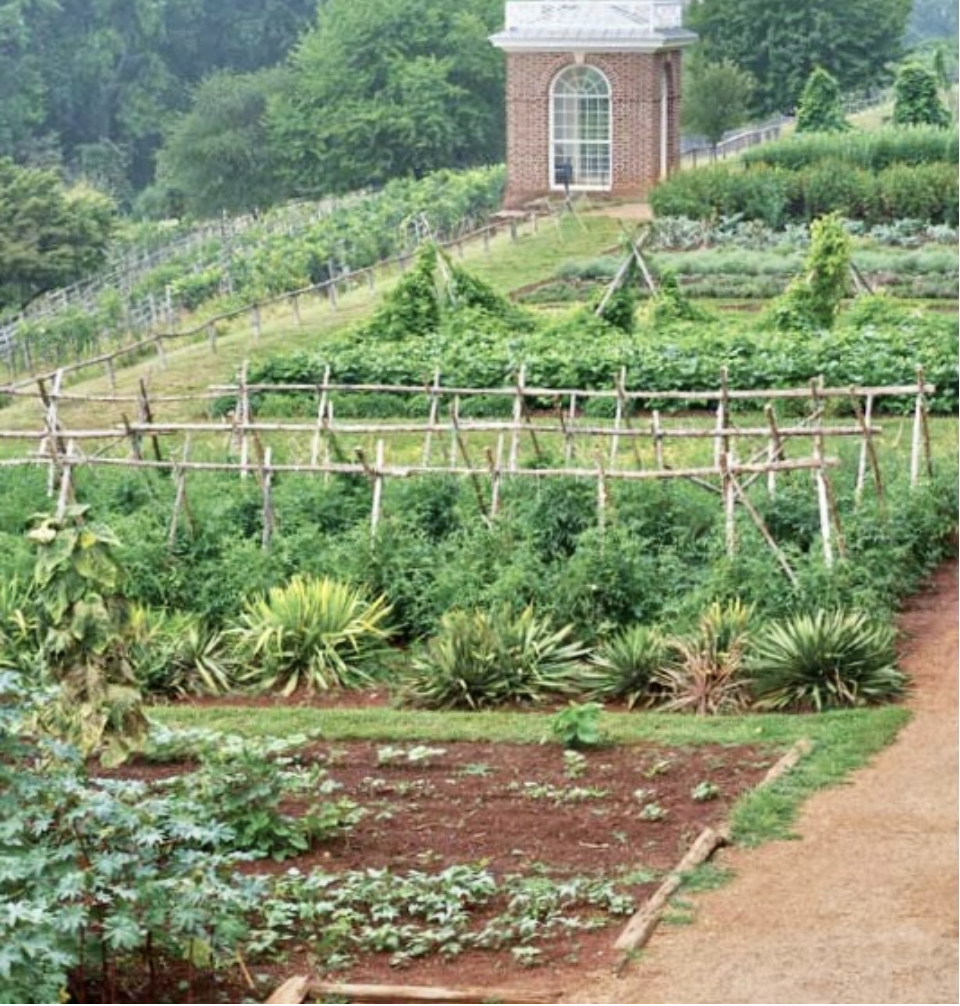
Photo credit: Susie Morris
By Maggie Mah
Maggie Mah is a UC Master Gardener of San Mateo and San Francisco Counties.
The subjects of gardening, the environment and the American struggle for independence might seem unrelated but in fact, they are tightly entwined. While nearly 90% of the colonial population were farmers, the key players in the creation of the new nation were agricultural visionaries. Their passion for plants and thirst for knowledge of the natural world was fueled both by their personal interests and by their collective desire for the country to endure and prosper. Washington, Jefferson, Adams, Madison and Franklin all agreed that sound agricultural practice was essential to the economic success of the new nation. The Founding Fathers were on the forefront of scientific research and were as equally passionate about gardening, agriculture and botany as they were about the battle for liberty. The more we discover, the more we understand why.
Agriculture is King: Ben Franklin was many things: scientist, inventor, writer and diplomate just to name a few. He was also an innovator and made no bones about the fact that the colonies needed to focus on agriculture. In 1769, he wrote “Positions to be examined concerning National Wealth,” in which he listed and opined upon three ways a nation could acquire wealth. “The first is by War… This is Robbery. The second is by Commerce, which is generally Cheating. The third by Agriculture is the only honest Way.”
At the time, manufacturing was forbidden in the colonies and had therefore become the prime market for imported British goods such as paper, fabrics, glass and other items. Meanwhile, the colonists were producing and shipping tobacco, indigo, rice and other valuable crops back to England. Franklin believed it was possible for the colonies to be self-sufficient and promoted the idea of boycotting British goods. He also knew that more work was needed if this idea were to succeed.
The Vast Fertile Fields of the New World? Franklin, Washington, Adams and Madison all expressed serious concerns over the health of colonial American farmland. Despite the traditional images of endless expanses of rich, productive fields, the land was becoming rapidly depleted. The reason: people from Europe had arrived in the New World and begun farming with the same methods used since the Middle Ages. In addition, many of them grew tobacco, a plant with several pernicious aspects including rapid soil depletion.
Without knowledge of crop rotation and the importance of soil health, land in the colonies was in decline. But land was abundant and once the soil became depleted, people simply moved on.
A Different Revolution: Meanwhile, during a stint in England in the 1750’s, Franklin had learned of another type of revolution taking place. Since the Old World was more crowded and had been subject to human exploitation for many centuries, the issue of soil depletion had become dire and the need for sustainable farming practices was urgent. Agricultural societies that promoted research and experimentation had sprung up and were promoting sound practices such as crop rotation and soil replenishment. Franklin’s observations and writings were key to the development of modern practices in America.
Much Ado About Manure: Due to the drastic decline in crop yields, the Founding Fathers became obsessed with the science of composting and soil regeneration to ensure the agricultural survival of the young nation. John Adams, while serving as American Minister to the Court at St. James Palace in London, famously dug his hands into a manure heap to compare the contents to one he maintained at home. He recorded the exact composition: a mixture of “stable straw, street sweepings, ditch mud, clay and turf.” Adams declared that it was good but that his own, a combination of Bostonian horse manure, seashore marsh mud and local street dust was superior.
Washington was particularly frustrated about what he considered the “abuse” of the land and contemptuously referred to “the slovenly farmers of this country.” Washington’s speeches and essays strongly encouraged American farmers to incorporate practices that would enrich their soils, instead of wearing them out. In order to provide sound information that could be relied upon, Washington set up his own meticulous scientific experiments and tested manure from horses, cows, pigs and sheep. His findings predated those of more famous soil scientists Carl Sprenger and Justus von Liebig.
Native Plants for the New Nation: Washington was also a proponent of native plants. While preparing to fight the British in Manhattan, he repaired to his quarters and wrote instructions for new plantings at Mount Vernon. He specified that only trees native to America were to be used. No English elements were allowed; be they soldiers or trees.
The Seed Trade: During this time of expansion and exploration, seeds from newly discovered plants were avidly collected and traded. Franklin gathered seeds during his travels in Europe and propagated plants that he believed had economic potential. He was also given seeds to distribute to American gardeners including olives, pistachios, carob soybeans, almonds, figs, capers, mangos and lychees.
Franklin’s botanical and agricultural interests were nurtured by a host of collectors and scientists — particularly John Bartram, a well-connected naturalist who used his affiliations to obtain seeds from far flung places. Among his associations was a certain Captain Bligh, whose post Bounty adventures included procuring plants and seeds from exotic places.
Thomas Jefferson was an avid gardener who transformed his plantation at Monticello into a living laboratory of plants. Jefferson’s garden was a testing ground for seeds gathered in Europe and from expeditions in North America by Lewis and Clark. He experimented with over 330 different varieties of fruits and vegetables, his favorite being peas. By planting 15 different varieties and staggering their planting times, he was able to enjoy fresh peas for several months. Jefferson exchanged seeds with other gardeners in America and abroad, keeping meticulous records of his successes and failures. His journals remain a reference for modern-day gardeners.
Jefferson’s holistic approach to gardening can be seen in a letter to his daughter, Martha Jefferson Randolph. After she complained of insects attacking the vegetables at Monticello, he wrote, “We will try this winter to cover our garden with a heavy coat of manure. When earth is rich it bids defiance to droughts, yields in abundance and best quality. I suspect that the insects which have harassed you have been encouraged by the lean state of the soil.”
James Madison, First Environmentalist: Madison was the fourth President, considered the “Father of the Constitution,” and author of the Bill of Rights. He was also an outspoken proponent of protecting the environment. As such, he was way ahead of his time. He saw the results of careless farming and that large expanses of forest were gone. People were leaving Virginia for new lands because the land was no longer productive. In 1818, Madison addressed the Agricultural Society of Albemarle, warning about humanity’s destructive impact and declaring that a place within the "symmetry of nature" must be found. Since most people of the time believed that nature was to be dominated and subdued, this was a radical idea. He noted how deforestation altered the climate and destroyed local ecosystems. He advocated for crop rotation, manure fertilization and the preservation of trees. Things didn’t change overnight but by the 1830’s, more people had begun to realize that preserving nature was essential.
When the Founding Fathers at last retired, they all returned to their estates and continued their interest in plants and gardening. Thomas Jefferson said it this way: “No occupation is so delightful to me as the culture of the earth, and no culture comparable to that of the garden. I am still devoted to the garden. But though an old man, I am but a young gardener.”
This article was originally posted in Coastside News in July 2026. https://www.coastsidenews.com/
UC Master Gardeners of San Mateo-San Francisco County are volunteers who are trained under the auspices of the University of California to provide science-based information on plants, horticulture, soil, and pest management at no charge to the public. UC ANR is an equal opportunity provider and employer.
For more information and to find out about classes and events in your area, visit our website where you can also sign up for our newsletter, connect with our social media channels and contact our Helpline: http://smsf-mastergardeners.ucanr.edu/
For more on John Adams’ manure exploration:https://www.masshist.org/publications/adams-papers/index.php/volume/DJA03/pageid/DJA03p194
For more on the importance of farming to the American revolution: https://www.amrevmuseum.org/read-the-revolution/founding-gardeners
For more on George Washington, the farmer:https://www.mountvernon.org/video/view/2zb4NRy2wKk?pid=PLr40fFkNNADGJUmxzTFaRBiLKBSVVZLUQ