Plastics Unwrapped
From our Founder, Anita Galeana
Since Bella CF expanded its mission to include conservation initiatives, it dawned on me that most people aren’t aware of just how ill our planet is. Most people are too busy surviving their jobs, raising their families, and paying bills. We’re all so stressed that I don’t blame people who don’t have time to care about one more thing— our planet. Not only are we stressed, but the whole web of life, from the smallest creatures to the largest mammals, are stressed and fighting existential threats. We are all in need of healing. We are all in need of saving.
Life sustaining pollinators, insects and the earth’s biodiversity are disappearing at an astounding rate. Scientists have coined this era the Sixth Mass Extinction. The world and its millions of ecosystems are complex and inter-dependent. Our actions or lack of actions in this complex web of life has consequences across the globe. I understand that I contribute to the illness of our planet, but I also want to do better and honor the generations to come. Stay with me and let’s see what we can do together.
For far too long we have been treating the planet as our garbage dump. The industrial age of the last century brought prosperity to many households, and my generation became expert consumers in the hunt for cheap and convenient things. The era of plastics, fast fashion and planned obsolescence for everything manufactured came about without our permission. We made progress on big polluters in industry dumping waste and toxic chemicals in our waterways, rivers and oceans, but we were blind to how we contributed to the plastic problem.
Single-use plastics are made up of petrochemicals (fossil fuel-based chemicals), usually for immediate or near immediate disposal. In the 1970s when I was a young woman, manufacturers began replacing paper or glass staples with this more “affordable” light weight alternative. Almost overnight, every manufacturer of goods was using plastic. Nine billion metric tons of plastics have been brought to markets, primarily over the past 26 years. This is a staggering amount of plastic polluting landfills, rivers, oceans and our bodies and there is no sign that production is decreasing. These materials are expected to stick around for thousands of years. It doesn’t take a genius or scientist to figure out that this is not sustainable.
I have taken countless food left-overs in black plastic containers, purchased water bottles for soccer games, hauled 10-pound plastic bottles of detergent and grabbed fruit packaged in plastic. During the pandemic take-out plastic containers spilled out my cupboards. Most of the time, the plastic got recycled or reused, but eventually all of it disappeared to an unknown place. I’m also guilty of buying Legos, plastic trucks and other plastic toys for my grandchildren without fully appreciating the risk to them or the planet. I never thought twice about buying synthetic clothing and although I try hard not to use plastic, it is everywhere! We’ve all heard the warnings, but we have a long way to go in understanding just how serious this problem is.
Early in the adoption of plastic, we believed if we recycled our plastics they were being repurposed into something new. For thirty years I’ve filled my recycling bin with paper, glass and plastics. I didn’t know what happened to the bin after it was picked up. But I’ve learned that, for decades our recycled plastics ended up in developing poor countries, far from the US. Most plastics being produced today is not being repurposed, and we are still being deceived by oil corporations and manufacturers of plastic.
The other issue with plastics is how they degrade over time into micro-plastics and release environmental toxins. I’ve heard that we all consume a credit card worth of plastic in our bodies in a year. Who knows if that is hyperbole or what the real amount is, but it’s not zero. We know plastic negatively affects the wildlife that ingest plastics. Plastics are infused with toxins that are proprietary knowledge to the companies who add them during manufacturing to make things such as: car parts, clothing, milk cartoons, aluminum cans, tea bags, dental floss, cosmetics, and tampons. There are also no regulations as to the chemicals involved in plastic production, including their properties, functions, hazards, prevalence and releases into the environment, the oceans, or our bodies.
Everything we do in our lives has consequences, even thousands of miles away. Laysan Albatross birds migrate every year to Midway Atoll by the hundreds of thousands to lay their eggs and raise their young. Midway is a remote island in the middle of the Pacific Ocean, and it should be pristine since it’s essentially uninhabited, except by the scientists who study these birds and plastic pollution. Many Albatrosses don’t make it to adulthood because the babies are fed plastics by their moms who scavenge the ocean for squid and fish but end up feeding their young plastics. Sadly, the ocean surrounding Midway is packed with plastic waste like bottle tops, toothbrushes, and other plastic fragments.
According to the National Oceanic, Atmospheric Association (NOAA), 11,000 pounds of plastic debris is brought by the Albatross feeding behavior to Midway each year. The photo below is a dead and decomposing Albatross with the plastic left in its digestive tract.
For most of us, plastic pollution is an invisible problem, but I hope by hearing this sad story of the Albatross, you may decide to use less plastic.
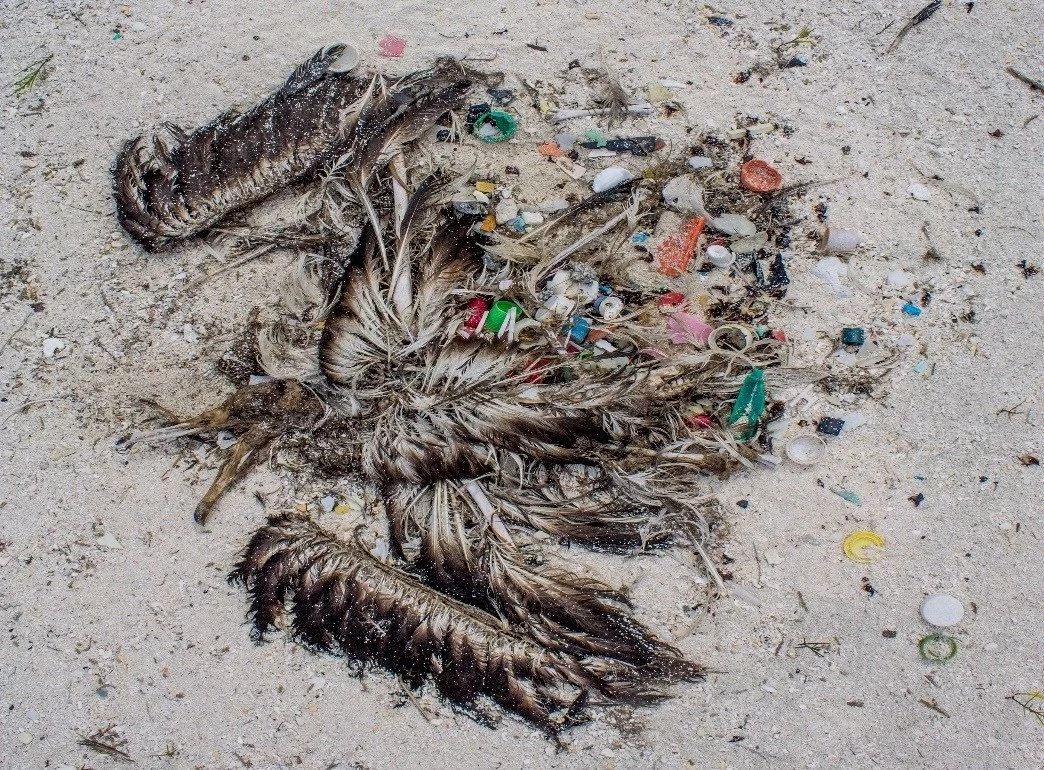
Photo credit: Eric Dale
This human behavior is not new. Some people see the earth as a place to extract money, in the form of coal, oil, gas, and rare compounds and minerals. Billions of dollars have flowed to a few, while the earth is ravaged and the oceans, rivers and waterways are being polluted. The pollution extends to the air we breathe, the water and food we ingest in the form of plastic poisons and microplastics. Our economy is based on growth, production and consumerism. Every corner of the earth has adopted technology, especially smartphones, cloud services and now AI tools. We can’t escape these technologies and their consequences to our planet, but we can educate ourselves and make smarter choices for ourselves and our one beautiful planet.
A Cleaner Conscience
Here are just a few things we can all do as a consumer, aside from simply consuming less:
Eliminate or reduce single-use plastics and share this commitment with family and friends. (Carry a reusable water bottle and coffee cup instead of buying bottled drinks.)
Bring your own glass food containers to restaurants for leftovers and choose products in glass, metal, or cardboard instead of plastic packaging whenever possible.
Bring sturdy reusable bags and produce bags for all shopping trips. Skip plastic bags entirely.
For your own health, never heat food in plastic containers, and drink filtered tap water.
Use loose-leaf coffee and tea.
Buy beverages in glass bottles (milk glass jars are free if you return them).
Buy in bulk and see if your city or town has a refillable retail store for shampoo, body wash and detergents.
Ask your city or town if they monitor micro-plastics in their water treatment facility.
Continue to recycle paper and plastics.
Buy natural cottons and avoid synthetic clothing or material.
Remember the trash we throw away does not disappear!
Special thanks to Manuel Maqueda, Instructor of Applied Circular Economics, and Regenerative Economics, Harvard Division of Continuing Education. I heard him lecture twice during a retreat at Esalen in Big Sur, California in 2025. His knowledge, humanity, and philosophy were transformative. His accomplishments are too long to list, but most notably he is co-founder of SUPER (Single-Use Plastics Elimination or Reduction), a nonprofit enabling businesses to eliminate single-use plastics through a tiered certification program. Visit https://www.super.ngo/ for more information.
References:
https://pmc.ncbi.nlm.nih.gov/articles/PMC12240811/
https://scienceline.org/2015/02/for-midway-atolls-birds-plastic-is-the-main-dish/
https://www.fisheries.noaa.gov/science-blog/midway-furious-five-rid-land-and-sea-marine-debris
https://www.nrdc.org/stories/single-use-plastics-101#why
https://rationalmiddle.com/episodes/the-circular-economy/
Featured monarch butterfly image photo credit: Patricia Galeana